What Marketers Can Learn from the Moonwalk: The Four Moves
Most marketing plans start with the same question: how do we get more people to see this? More budget, more channels, more posts. It is a reasonable question, but it is not the one that made Michael Jackson the King of Pop. He did not win by advertising harder. He won by making work that people could not stop talking about, by signing that work so it could never be mistaken for anyone else's, and by holding a standard that audiences could feel even when they could not explain it.
The Four Moves takes those habits and turns them into a practical guide for anyone who markets a product or a service. It is short on theory and long on things you can do this week. Here is how it works.
The four moves behind the process
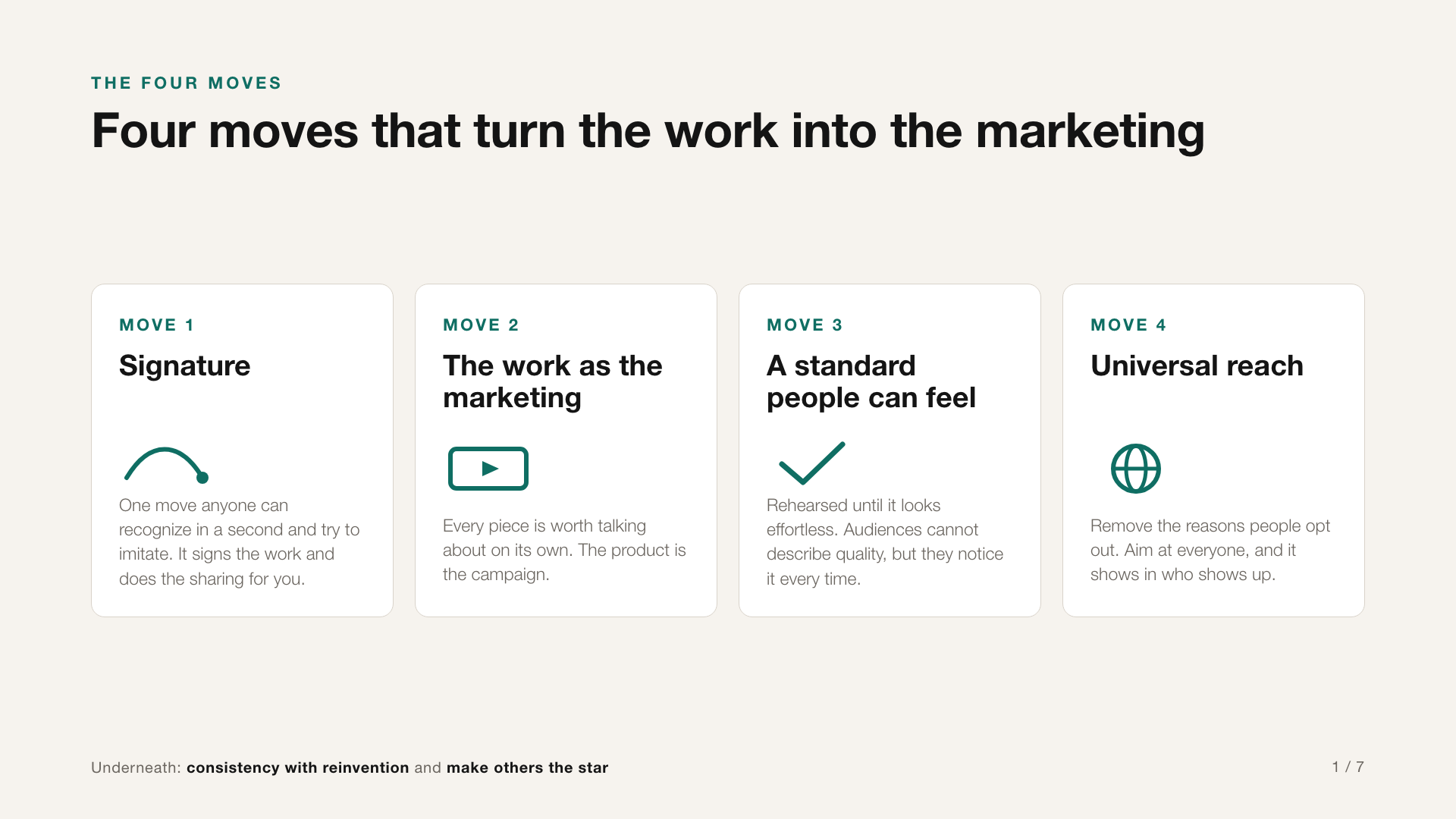
The process rests on four things Michael Jackson did relentlessly.
He created a signature. The moonwalk is one move. Anyone can recognize it in a second, and almost anyone will try to imitate it. That is the whole point of a signature: it makes the work unmistakable, and it gives people something they can copy and pass along to others. A signature does the sharing for you.
He made the work the marketing. Every video and every performance was built to be worth talking about on its own. There was no separate campaign that had to explain why the show mattered. The product was the campaign.
He held a standard people could feel. He rehearsed until the result looked effortless. Audiences rarely have the vocabulary to describe quality, but they notice it every single time, and they notice its absence too.
He aimed for universal reach. He removed the reasons people might opt out. Language, genre, age, geography: none of them were allowed to become a barrier. He aimed at everyone, and it showed in who showed up.
Underneath these four moves sit two supporting habits. The first is consistency with reinvention: the signature never changed, but the show always did. The second is making others the star. Dancers, directors, and fans became distributors of the work because they were part of it.
Universal principles for every marketer
Whether you sell a product or a service, these principles apply.
Pick one signature and freeze it. Choose a single visual, phrase, ritual, or format that appears in everything you release and belongs only to you. Then commit to it for at least a year. Recognition comes from repetition, not from novelty. The temptation to refresh it every quarter is exactly what keeps most brands forgettable.
Not everything qualifies. Before you commit, run the candidate through three questions:
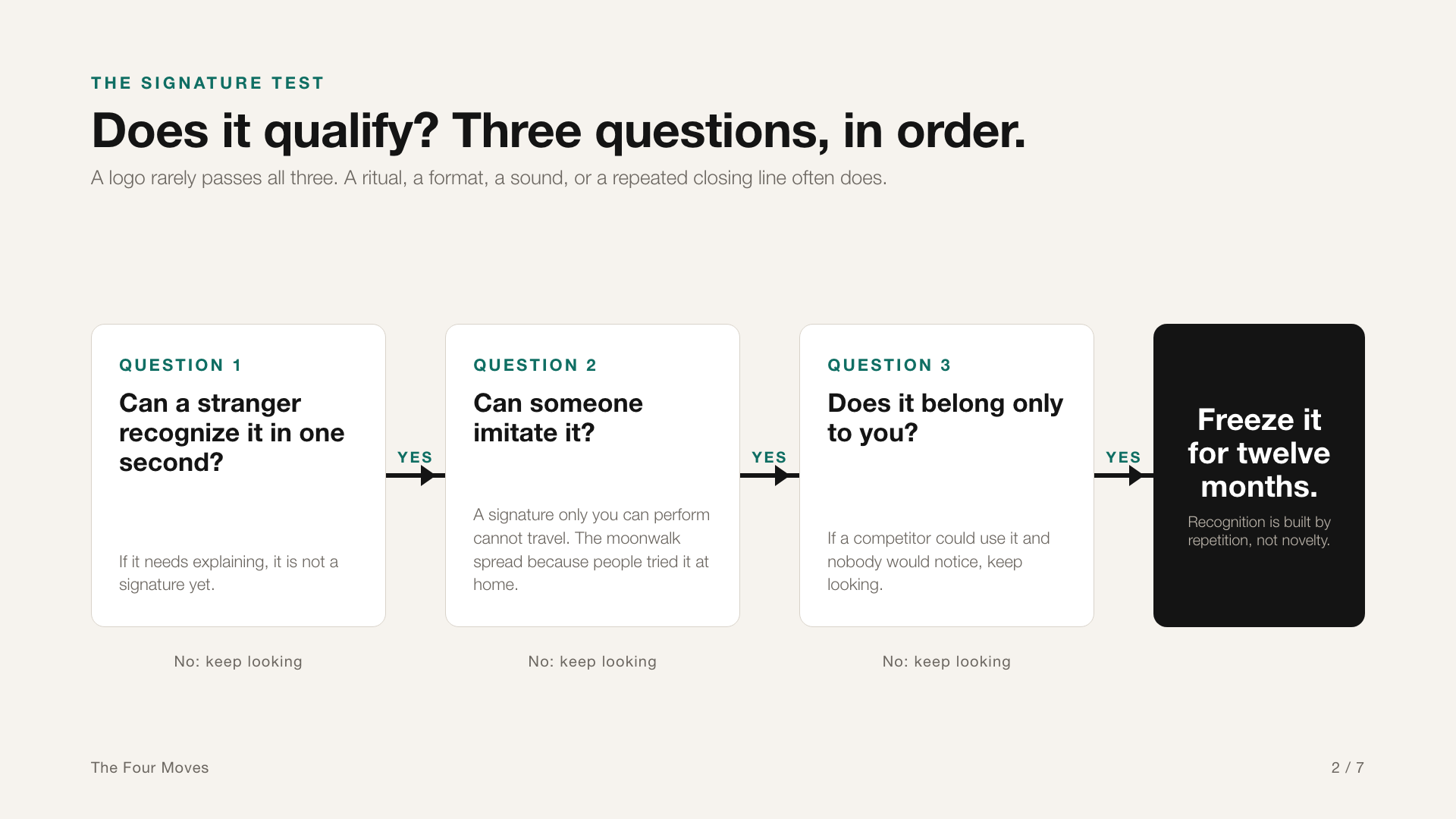
- Can a stranger recognize it in one second? If it needs explaining, it is not a signature yet.
- Can someone imitate it? A signature that only you can perform cannot travel. The moonwalk spread because people tried it in their kitchens.
- Does it belong only to you? If a competitor could use it without anyone noticing, keep looking.
A logo rarely passes all three. A ritual, a format, a sound, or a repeated closing line often does.
He engineered recognizability
The moonwalk was not the only signature Michael Jackson had. It was one asset in a system. He owned a recognizable move on nearly every channel a performer can be recognized on:
| Channel | Signature |
|---|---|
| Movement | The moonwalk |
| Pose | The toe stand |
| Gesture | The fedora tip |
| Motion | The spin and the sudden stop |
| Impossible visual | The Smooth Criminal lean |
| Vocal | "Hee-hee," "Ow," "Shamone" |
| Rhythm | Vocal breaths used as percussion |
| Wardrobe | One glove, the fedora, white socks, black loafers |
| Silhouette | Bent knees, tilted body |
| Music | Huge bass and riff-driven hooks |
| Dynamics | Stillness, then explosion |
| Visual storytelling | Cinematic music videos |
| Persona | Mystery, precision, spectacle |
He did not simply have a recognizable look. He created repeatable brand assets. The moonwalk is an asset. "Hee-hee" is an asset. The glove is an asset. The fedora is an asset. The toe stand is an asset. The silhouette is an asset. Each one says Michael Jackson without saying Michael Jackson.
That is the standard for yours. A business has fewer channels than a performer, but it has more than it uses. The same idea, owned in more than one place:
| Channel | His asset | Yours could be |
|---|---|---|
| Object | The glove | The thing customers keep or carry |
| Sound | "Hee-hee" | The click, the chime, the spoken line |
| Words | "Shamone" | A phrase only you say |
| Ritual | The toe stand | A fixed moment of handoff |
| Silhouette | Bent knees, tilted body | One shape or color you can spot at a distance |
| Format | The cinematic video | The same frame, every time |
| Dynamics | Stillness, then explosion | How your work opens and how it lands |
| Persona | Mystery and precision | The temperament people come to expect |
One first, then stack. He froze the moonwalk in 1983 and kept adding assets for a decade. Do it in that order. Pick one signature and prove it travels. Then own the same idea in a second channel, then a third. Run every new asset through the same three questions, and one more that matters most: does it say you without saying you? A brand with one signature is recognizable. A brand with a stack of them is unmistakable.
Make one thing people would want even if it sold nothing. Before you plan a campaign, ask a harder question: what would our audience save, forward, or come back to on its own? Build that first. Then let it carry the offer. Work that earns attention does not need to buy it.
Write the standard down. Create a short checklist that every piece must pass before it goes out. Excellence is felt before it is understood, and a checklist is how you make sure it is felt every time. Here is a version you can use as is:
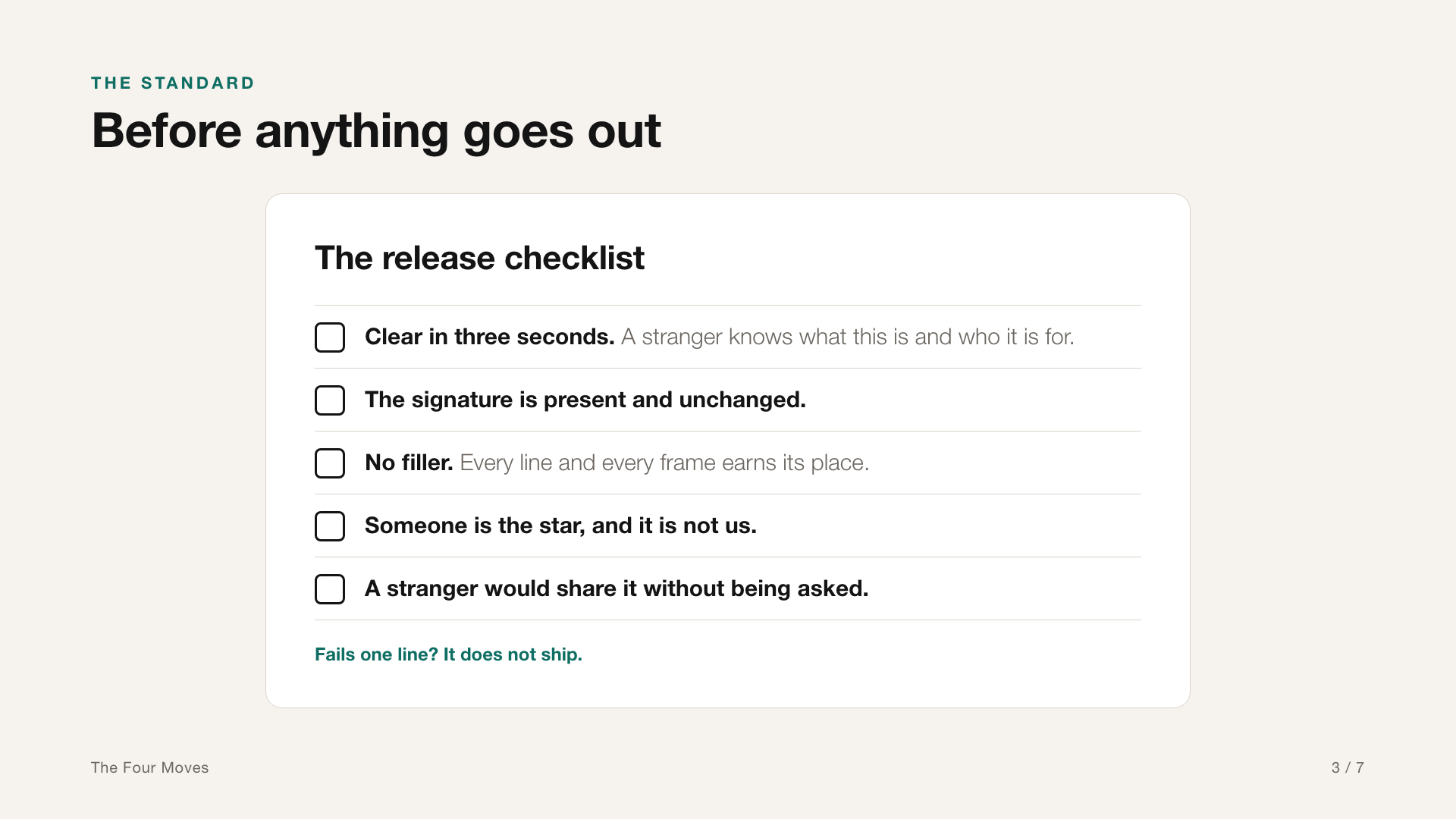
Before anything goes out
- Clear in three seconds. A stranger knows what this is and who it is for.
- The signature is present and unchanged.
- No filler. Every line and every frame earns its place.
- Someone is the star, and it is not us.
- A stranger would share it without being asked.
Print it. Tape it up. If a piece fails one line, it does not ship.
Remove opt-outs instead of arguing with them. List every reason a qualified person says "not for me." Then design each one away rather than writing copy that tries to talk people out of it. The five most common opt-outs, and the shape of the fix:
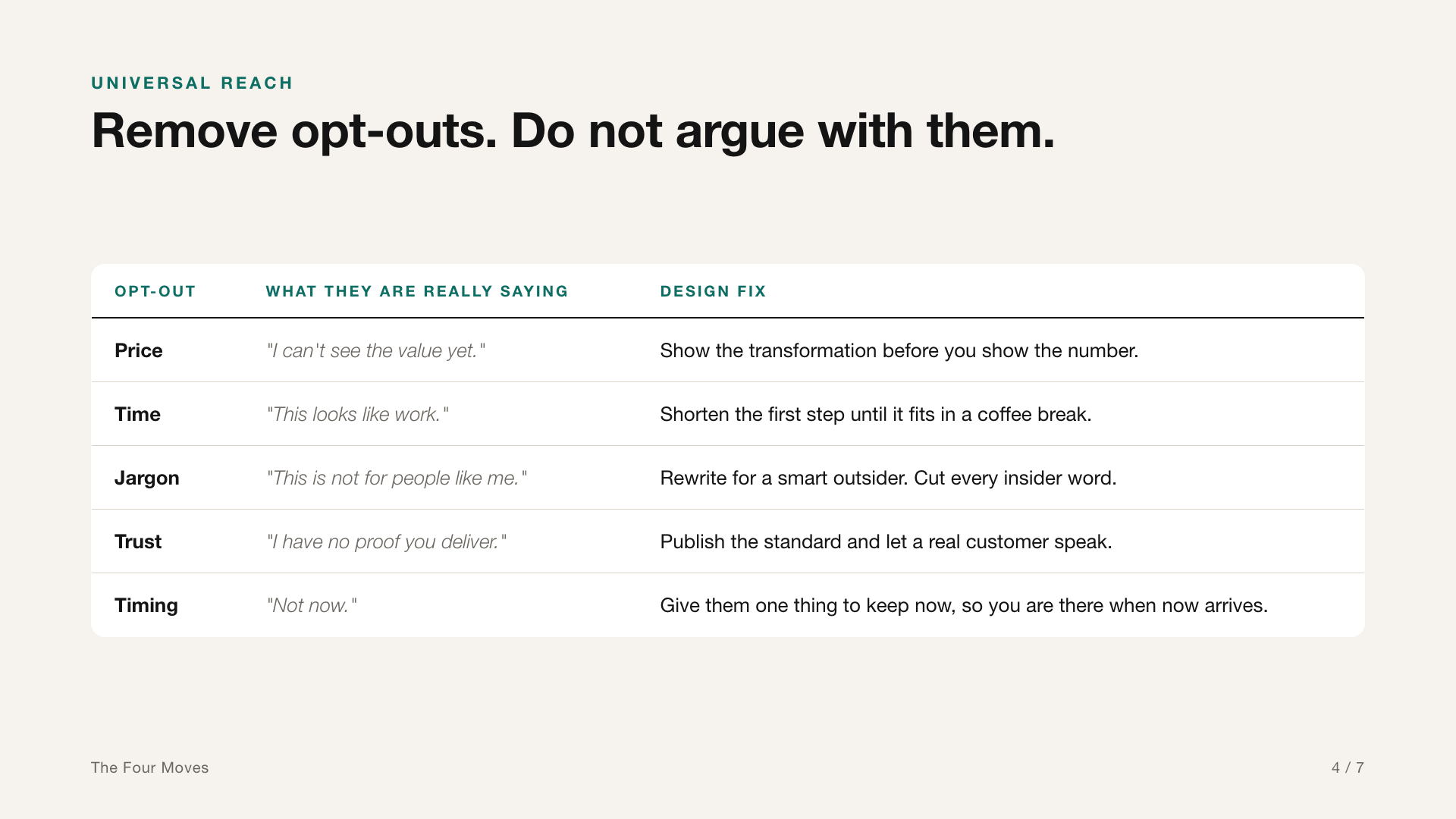
| Opt-out | What they are really saying | Design fix |
|---|---|---|
| Price | "I can't see the value yet." | Show the transformation before you show the number. |
| Time | "This looks like work." | Shorten the first step until it fits in a coffee break. |
| Jargon | "This is not for people like me." | Rewrite for a smart outsider. Cut every insider word. |
| Trust | "I have no proof you deliver." | Publish the standard and let a real customer speak. |
| Timing | "Not now." | Give them one thing to keep now, so you are there when now arrives. |
Fix the frame and rotate the content. Decide what stays constant for twelve months and what changes each quarter. Change keeps attention. Constancy builds recognition. You need both, and you need to be deliberate about which is which.
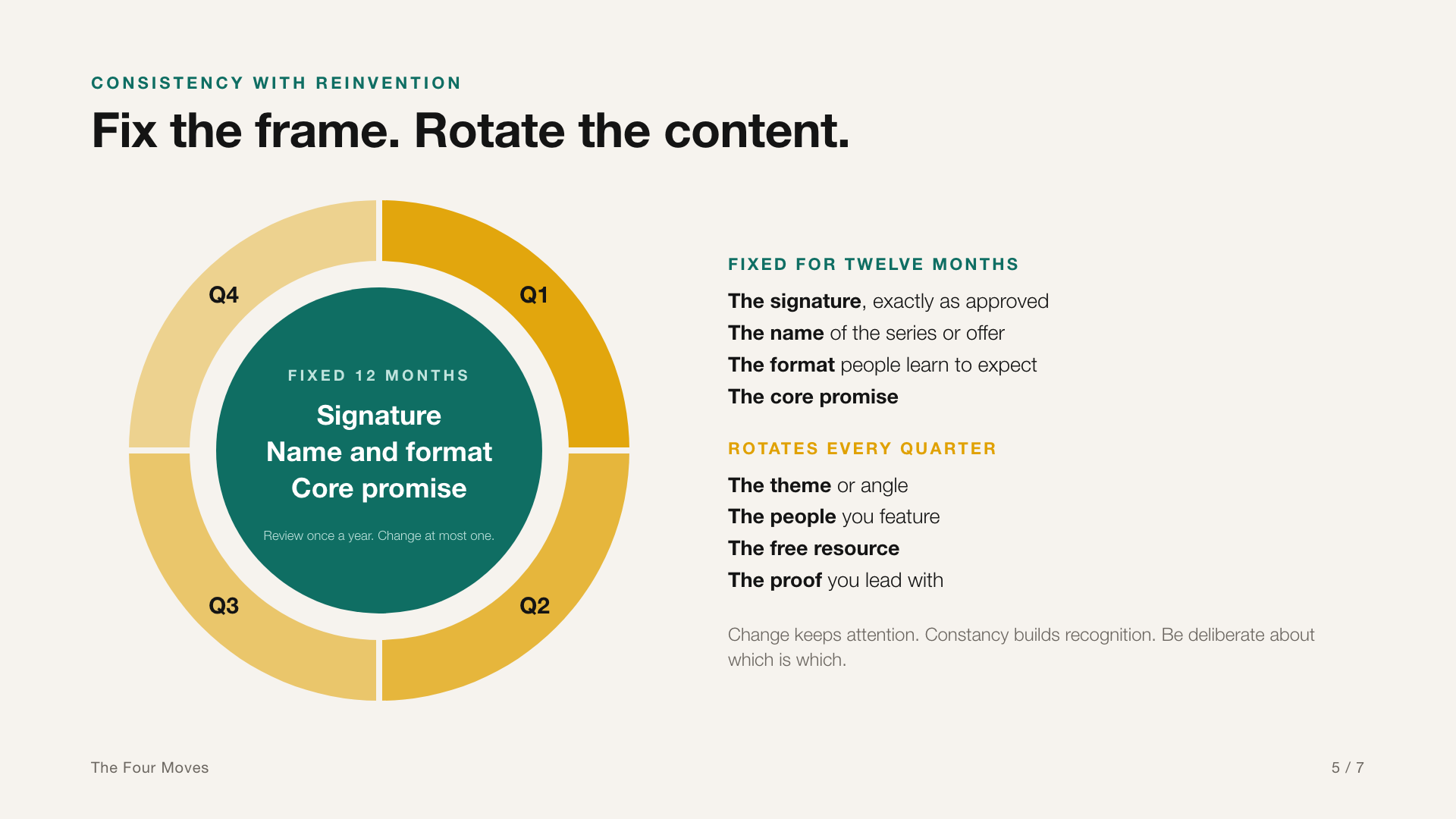
For twelve months, freeze the signature, the name of the series or offer, the format, and the core promise. Each quarter, rotate the theme, the people you feature, the free resource, and the specific proof you lead with. When the year ends, review the fixed core once, change at most one element, and freeze it again.
Let others carry it. Feature customers, partners, and staff so that they have a real reason to share. Reach borrowed from people who are proud of their part in the work is far cheaper than reach you rent.
Measure three things. You do not need a dashboard with forty numbers. You need three that tell you whether the framework is working:
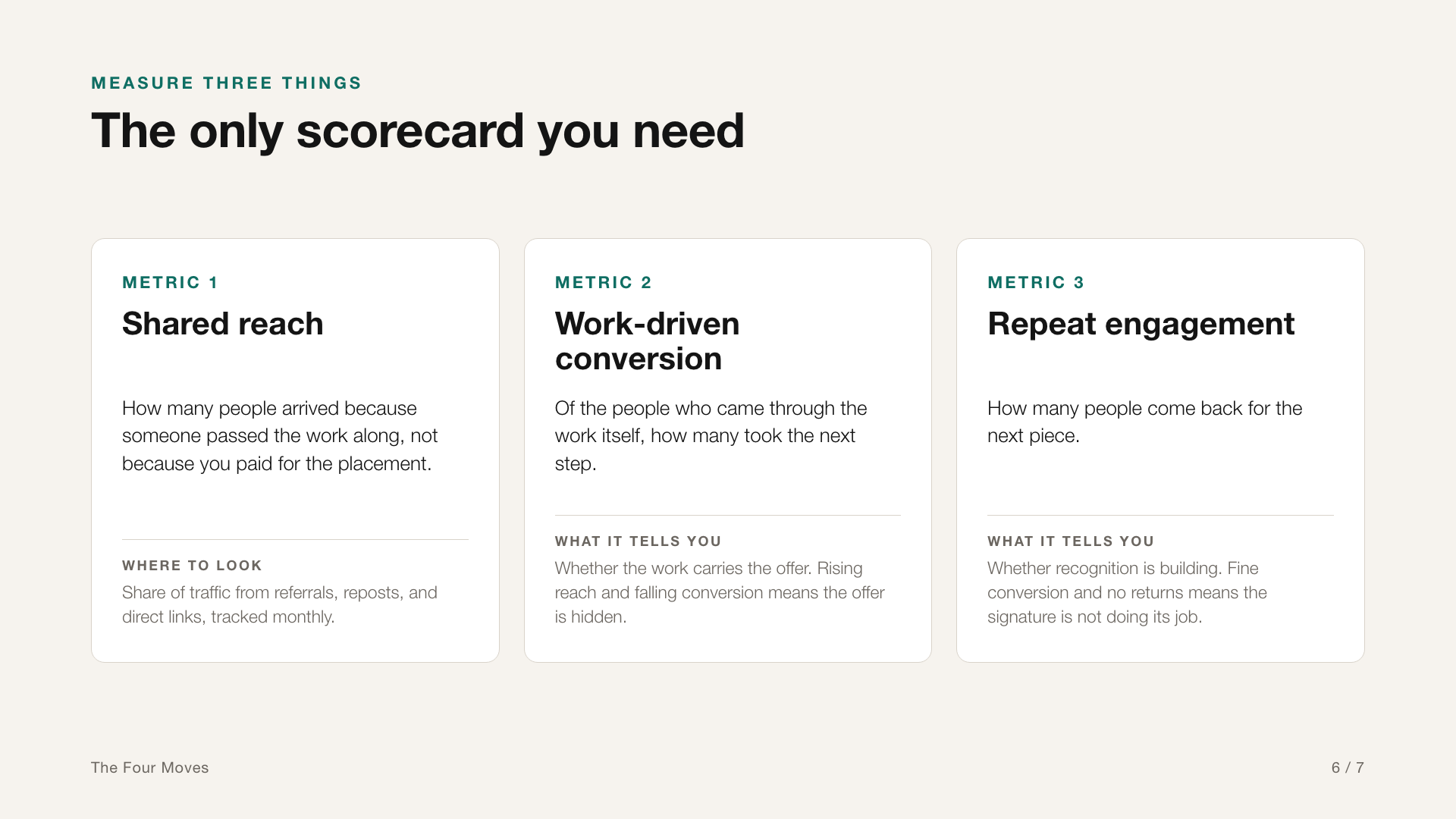
- Shared reach. How many people arrived because someone passed the work along, not because you paid for the placement. Watch the share of traffic that comes from referrals, reposts, and direct links.
- Work-driven conversion. Of the people who came through the work itself, how many took the next step. This tells you whether the work carries the offer.
- Repeat engagement. How many people come back for the next piece. Repetition is where recognition is built, and this is the number that proves it is happening.
Track them monthly. If shared reach rises while conversion falls, the work is good but the offer is hidden. If conversion is fine but nobody comes back, the signature is not doing its job.
If you market a product
Products are held, unboxed, and shown. That means the signature can live on the object itself.
Put the signature on the product: a shape, a color, a sound, or an unboxing moment that shows up in every customer photo without you asking. Make the demonstration the content by showing the product doing the one thing it does best in under fifteen seconds, in the same format every time. Design for the second-hand audience by asking what this looks like on someone else's feed, desk, or shelf. Rotate limited editions, colorways, or bundles each quarter while keeping packaging, name, and core promise fixed. And turn customers into the show with a standing feature: real customer, real use, real setting, same format each time.
If you market a service
Services are invisible until they are delivered. The signature has to live in the experience and in the proof.
Sign the delivery with a named first step, a recognizable deliverable format, and a closing ritual that clients can describe to a friend. Make the proof the content by showing the transformation, before and after, in a fixed format that stays the same across every client story. Publish the standard: a visible quality checklist or guarantee turns an invisible service into something people can trust before they buy. Rotate the case studies, the industries you spotlight, and the free resource each quarter, while keeping the method, the name, and the promise fixed. And make clients the star. Every engagement should produce something they are proud to share, with their name on it before yours.
Two worked examples
The brands below are invented, so the details are illustrative. The point is to show what the four moves look like when a real team sits down to apply them.
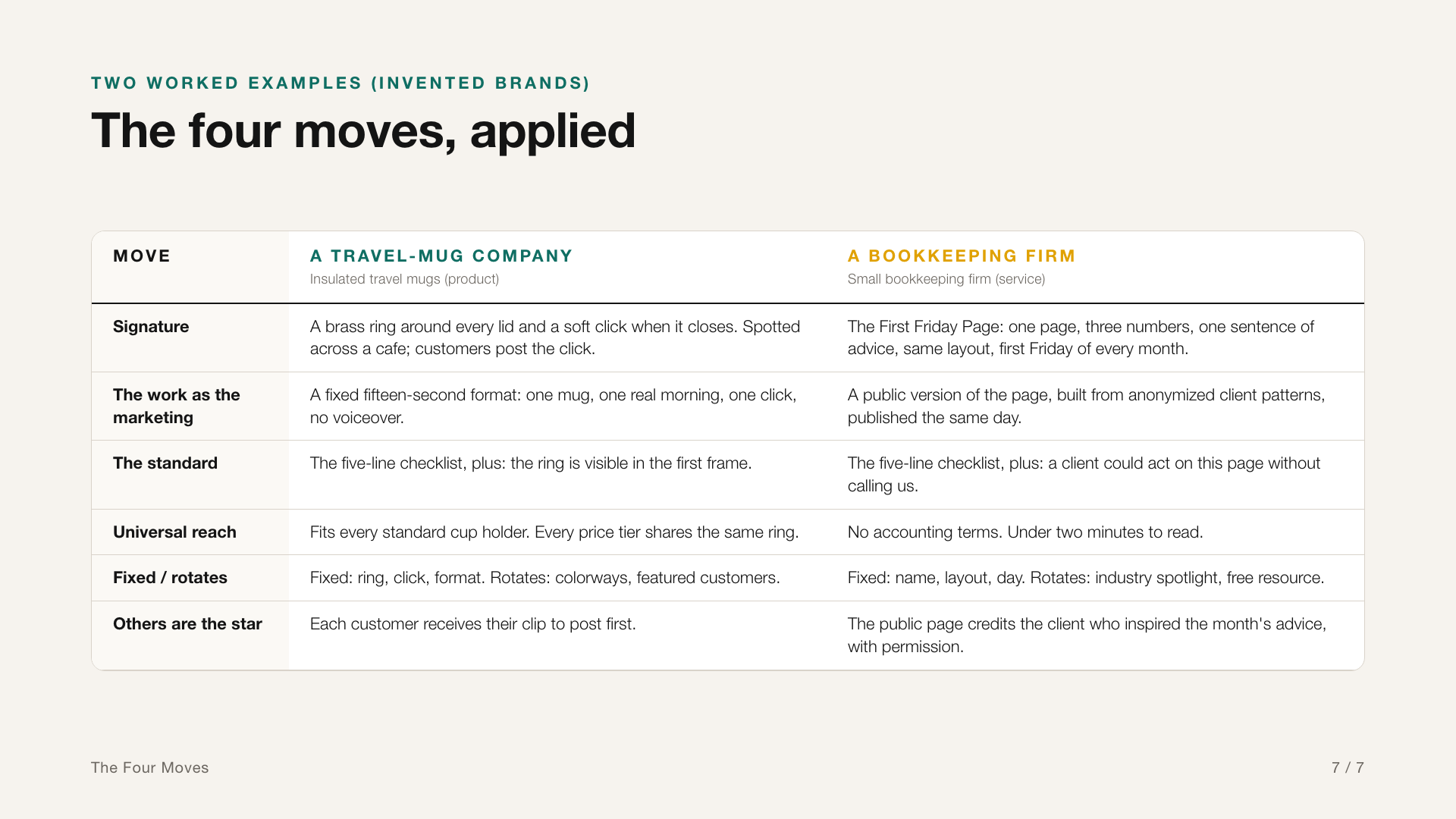
A product: A travel-mug company, maker of insulated travel mugs.
The mug company's signature is a single brass ring around the lid, present on every mug in every color, and a soft click when the lid closes. Anyone can spot it across a cafe, and customers imitate it without meaning to by posting the click. The work that is the marketing is a fixed fifteen-second format: one mug, one real customer's morning, one click, no voiceover. The standard is the five-line checklist above, plus one line just for them: the ring must be visible in the first frame. Universal reach means the mug fits every standard cup holder and every price tier shares the same ring, so nobody is designed out. Fixed for the year: the ring, the click, the fifteen-second format. Rotating each quarter: colorways and the customers featured. Customers are the star, and each one receives their clip to post first.
A service: A bookkeeping firm.
The firm's signature is the First Friday Page: on the first Friday of every month, every client receives a one-page summary in the same layout, three numbers and one sentence of advice. Clients describe it to friends without prompting, which is the whole test. The work that is the marketing is a public version of that page, built from anonymized patterns across their clients, published on the same first Friday. The standard is the checklist plus one line: a client could act on this page without calling us. Universal reach means the page uses no accounting terms and takes under two minutes to read. Fixed for the year: the name, the layout, the day it arrives. Rotating each quarter: the industry they spotlight and the free resource attached. Clients are the star, and the public page credits the client who inspired each month's advice, with permission.
Where to start this week
You do not need a new budget to begin. You need four decisions.
- Name your signature and write it in one sentence. Run it through the three-question test.
- Draft your five-line quality checklist, or adopt the one above.
- List your top three opt-outs and one fix for each.
- Choose the one piece of work you will make before you make an ad.
The takeaway
Michael Jackson did not reach the whole world by shouting louder than everyone else. He gave people something unmistakable, made it worth sharing, held it to a standard they could feel, and made room for everyone to join in. The Four Moves asks you to do the same with whatever you sell. Freeze the signature, make the work the marketing, write the standard down, remove the reasons to say no, and let the people you feature carry it further than you could alone.
Start with the signature. Everything else follows from it.
If this was useful, share it with the person on your team who owns the next campaign, and ask them what their signature is.
Try it on your own product or service
Type what you make or do and get a four-move card with a link you can share. Results can take 1–2 minutes.
Four Moves generator →